
Cataracts develop slowly. By the time surgery is recommended, many patients have spent years squinting through glare, dimmed colors, and headlights that seem far brighter than they used to. Knowing what happens after the procedure takes much of the uncertainty out of the experience. Most people resume usual activities quickly, though complete healing continues quietly for several weeks afterward.
Key Takeaways
- Cataract surgery is an outpatient procedure, and most patients go home the same day.
- Many people notice improved vision within hours, while full internal healing can take six to eight weeks.
- Prescribed eye drops, a protective eye shield, and short-term activity limits all support a smooth recovery.
- Mild discomfort, a gritty feeling, and light sensitivity are common in the early days but tend to ease quickly.
- Follow-up exams allow your eye surgeon to monitor healing, treat any concerns early, and confirm your vision is progressing as expected.
How Cataracts Affect Vision
A cataract forms when the natural lens inside the eye gradually clouds over, most often as part of the aging process. As a cataract prevents light from focusing clearly, patients often describe blurry vision, faded colors, glare from headlights or bright lights, and difficulty seeing well at night. According to the National Eye Institute, cataracts are among the most common causes of vision loss in older adults, though they are also highly treatable.
Cataracts can develop in one or both eyes, and they do not always progress at the same rate. Other eye conditions, including diabetic retinopathy, glaucoma, and macular degeneration, can sometimes coexist with cataracts, which is one reason a comprehensive eye exam matters before surgery is scheduled.
What Happens During Cataract Surgery
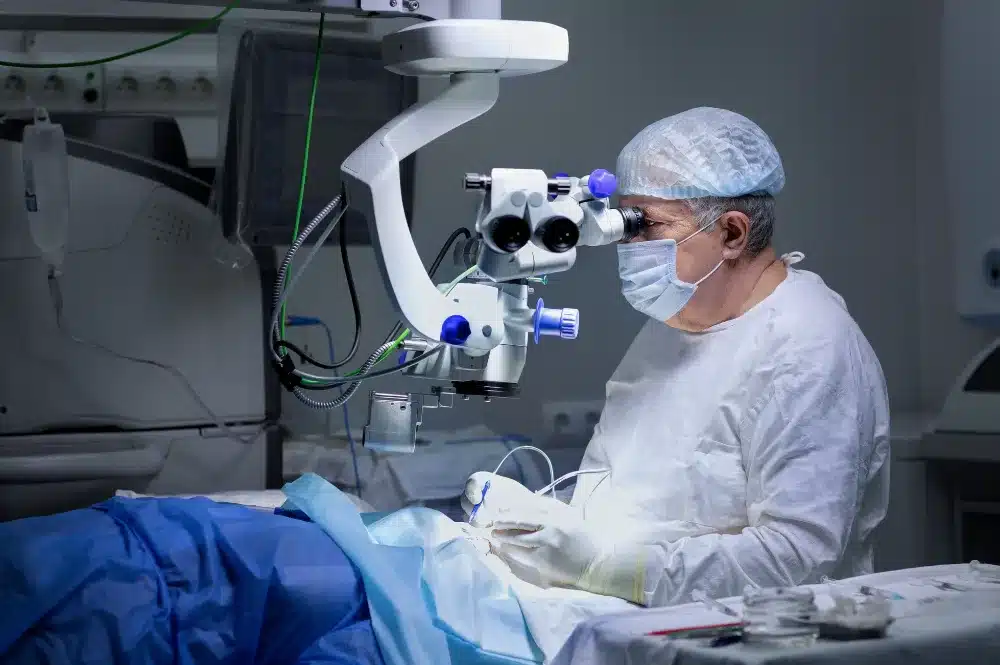
During cataract surgery, your surgeon removes the cloudy natural lens and replaces it with a new intraocular lens, often called an IOL. The most common technique, phacoemulsification, uses ultrasound energy to break the lens into small pieces that can be removed through a tiny incision rather than a large incision, which supports a faster, more comfortable recovery.
The procedure itself typically takes 20 to 30 minutes, though individual experiences vary, and most patients are in the office longer to allow for preparation and postoperative instructions. Numbing drops and light sedation keep the eye comfortable throughout, and most patients experience only mild discomfort rather than real pain.
Intraocular lenses are made from plastic, acrylic, or silicone materials, and many designs include a coating that blocks ultraviolet light to help protect the eye going forward. Your surgeon will recommend a lens based on your eye health, prescription, and how you use your vision day to day.
Cataract Surgery Recovery Time, Day by Day
The first 24 hours
Vision is often blurry or hazy right after surgery, which is expected while the eye adjusts. Mild itching, watering, and sensitivity to bright lights are common for a couple of days. A protective shield or eye patch is usually worn while sleeping to prevent accidental rubbing, since avoiding rubbing the eye is one of the most important instructions during this window. Rest and avoid bending at the waist or lifting heavy objects.
The first week
Many patients notice clearer vision within hours to a few days, and colors often look more vivid than they have in years. A follow-up visit is typically scheduled within the first day or so after surgery so your eye doctor can check healing and eye pressure. Swimming, hot tubs, dusty environments, and other activities that risk introducing bacteria near the eye should be avoided during this period.
Weeks two through eight
Complete internal healing after cataract surgery generally takes about six to eight weeks, even though most people feel back to normal well before then. Some day-to-day fluctuation in vision is expected as the eye settles. Once vision stabilizes, many patients receive an updated glasses prescription. If both eyes need treatment, the second surgery is usually scheduled once the first eye has healed enough for your surgeon to evaluate the outcome.
Possible Complications and When to Call Your Surgeon
Cataract surgery complications are uncommon, and most patients recover without significant issues. Risk can increase in patients with other eye diseases, so your surgeon reviews your full eye health before recommending surgery. Rare complications can include infection, retinal detachment, or swelling, and prompt evaluation matters if problems do occur.
Contact our office right away if you experience sudden vision loss, severe pain, a sudden increase in flashes or floaters, or vision that seems to be getting worse rather than better. Most concerns caught early can be managed effectively, which is part of why follow-up exams are highly recommended even after vision feels clear.
Secondary Cataracts and YAG Laser Capsulotomy
Occasionally, the membrane that holds the new intraocular lens in place becomes cloudy months or years after the original surgery. This is known as a secondary cataract, or posterior capsule opacification, and it is not a sign that the cataract has returned. Your surgeon can treat this quickly and comfortably with a YAG laser capsulotomy, a brief in-office procedure that clears the membrane and typically restores clear vision within a day or two.
Supporting a Smooth Recovery
Using prescribed eye drops exactly as directed is one of the most important parts of recovery, since they reduce inflammation and lower the risk of infection while the eye heals. Wearing your protective shield at night, avoiding heavy objects, and easing back into other activities gradually all give the eye the best chance to heal well. Most patients see clearly enough to resume driving, reading, and other everyday tasks within a short time, though your surgeon will confirm when it is safe based on your individual healing.
Why Choose Intermountain Eye Center
Intermountain Eye Center has provided cataract surgery and comprehensive eye care throughout the Treasure Valley for more than 60 years. Our ophthalmologists and optometrists coordinate cataract treatment alongside glaucoma, retina, and cornea care, along with contact lenses and eyeglasses, all within the same practice. The entire staff is here to answer questions and support you through every stage of recovery, from your first consultation through your final follow-up exam.
Protect Your Vision for the Years Ahead
Recovery is easier to navigate when you know what to expect, and having an experienced surgeon monitoring your healing matters as much as the surgery itself. Intermountain Eye Centers has cared for patients across Boise and the Treasure Valley for more than six decades, offering cataract surgery alongside glaucoma, retina, cornea, and routine eye care within one multi-specialty practice.
If cataract symptoms are affecting your driving, reading, or comfort in bright light, request a consultation with a cataract specialist in Boise. Call our office to schedule your eye exam and find out whether lens replacement surgery is right for you.
Frequently Asked Questions
How long is cataract surgery recovery time?
Many patients notice improved vision within days, while complete internal healing can take six to eight weeks. Activity restrictions are usually lifted gradually during the first week, and your surgeon will confirm your progress at each follow-up visit.
Is cataract surgery painful?
Most patients experience only mild discomfort, not real pain. Numbing drops and sedation keep the eye comfortable during surgery, and a gritty feeling or light sensitivity afterward typically fades within a few days.
How long does cataract surgery take?
The procedure itself usually takes 20 to 30 minutes per eye. Plan for a longer visit overall, since preparation and postoperative instructions add time, and most patients go home the same day.
What are the first signs of cataracts?
Common cataract symptoms include blurred vision, glare or halos around lights, faded colors, and trouble seeing well at night. A comprehensive eye exam can confirm whether cataracts, or another eye condition, are the cause.
Will I need glasses after cataract surgery?
Many patients reduce their reliance on glasses, though most still use them for certain tasks depending on the intraocular lens chosen. Your surgeon can discuss premium lens implants in Boise if reducing glasses dependence is a priority for you.
What if my vision clouds up again months after surgery?
That is usually a secondary cataract rather than a new cataract, caused by clouding of the membrane behind the lens. It is treated quickly with a YAG laser capsulotomy, a simple in-office procedure with a fast recovery.